
You might be interesting:

Labradorite Stairs: Black Stone for Architecture That Holds Its Shape Over Time
10 min | 20.03.2026Labradorite Stairs: Black Stone for Architecture That Holds Its Shape Over Time
Black Stone Stairs in Contemporary Architecture


Why Labradorite Stairs Are Chosen for Premium Projects
In well-considered architecture, stairs are never only about function. They shape movement, set the rhythm of space, and often become one of the first elements through which an interior or entrance sequence is perceived.
That is why the material chosen for stairs must work beyond the moment of completion. It should remain convincing over time — visually, tactually, and structurally.
When architects and clients look for a dark natural stone, the choice often begins with an image: depth of tone, a composed surface, a sense of mass and permanence. But for stairs, that alone is not enough. The material must also preserve its character under daily use.
This is why labradorite is increasingly seen as one of the most precise materials for stairs. It combines the restrained expression of black stone with the dense natural structure that architecture values just as much as visual impact.
For Golovinski, labradorite is not a decorative gesture. It is a material that belongs in spaces defined by proportion, clarity of line, and long-term relevance without unnecessary excess.
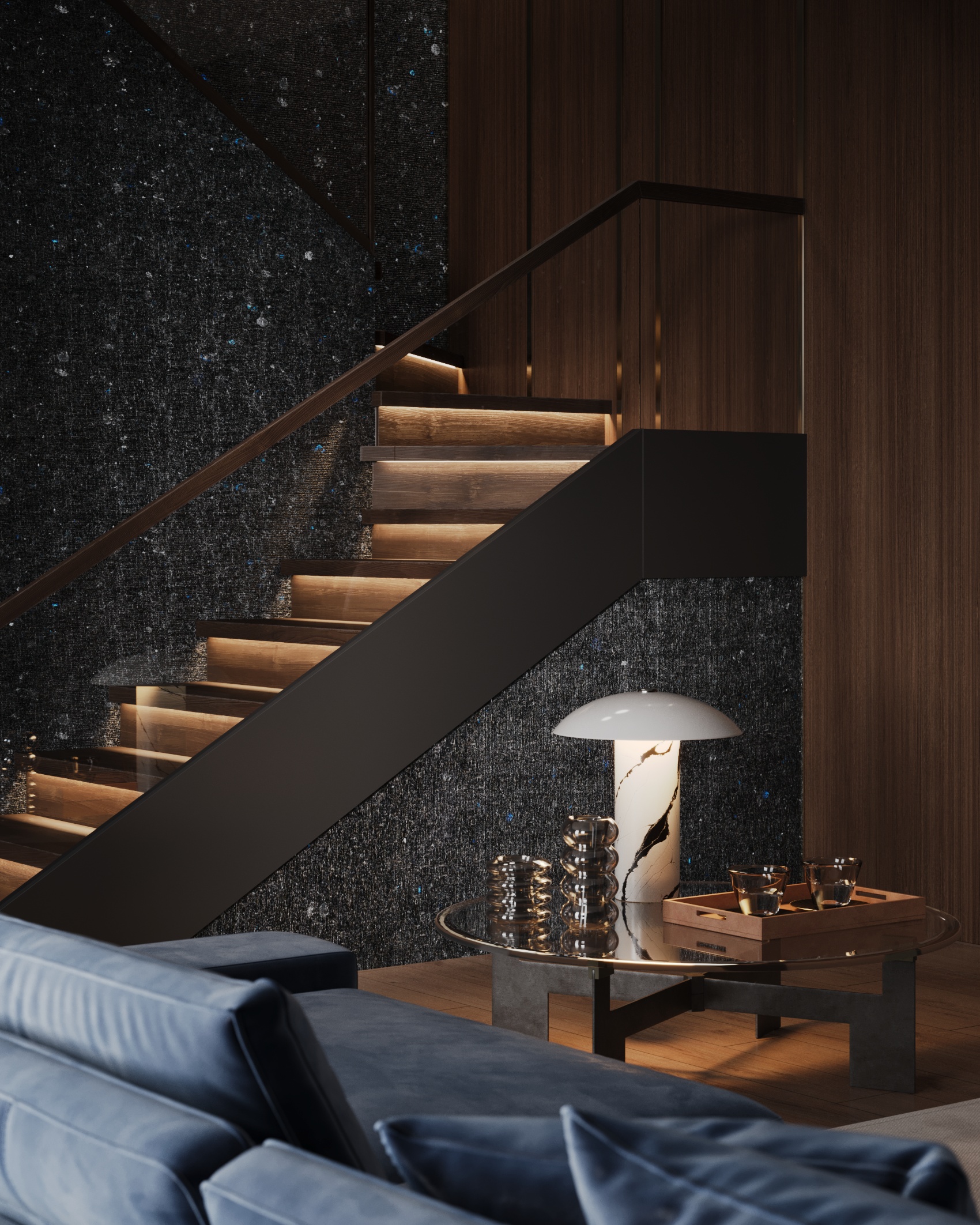
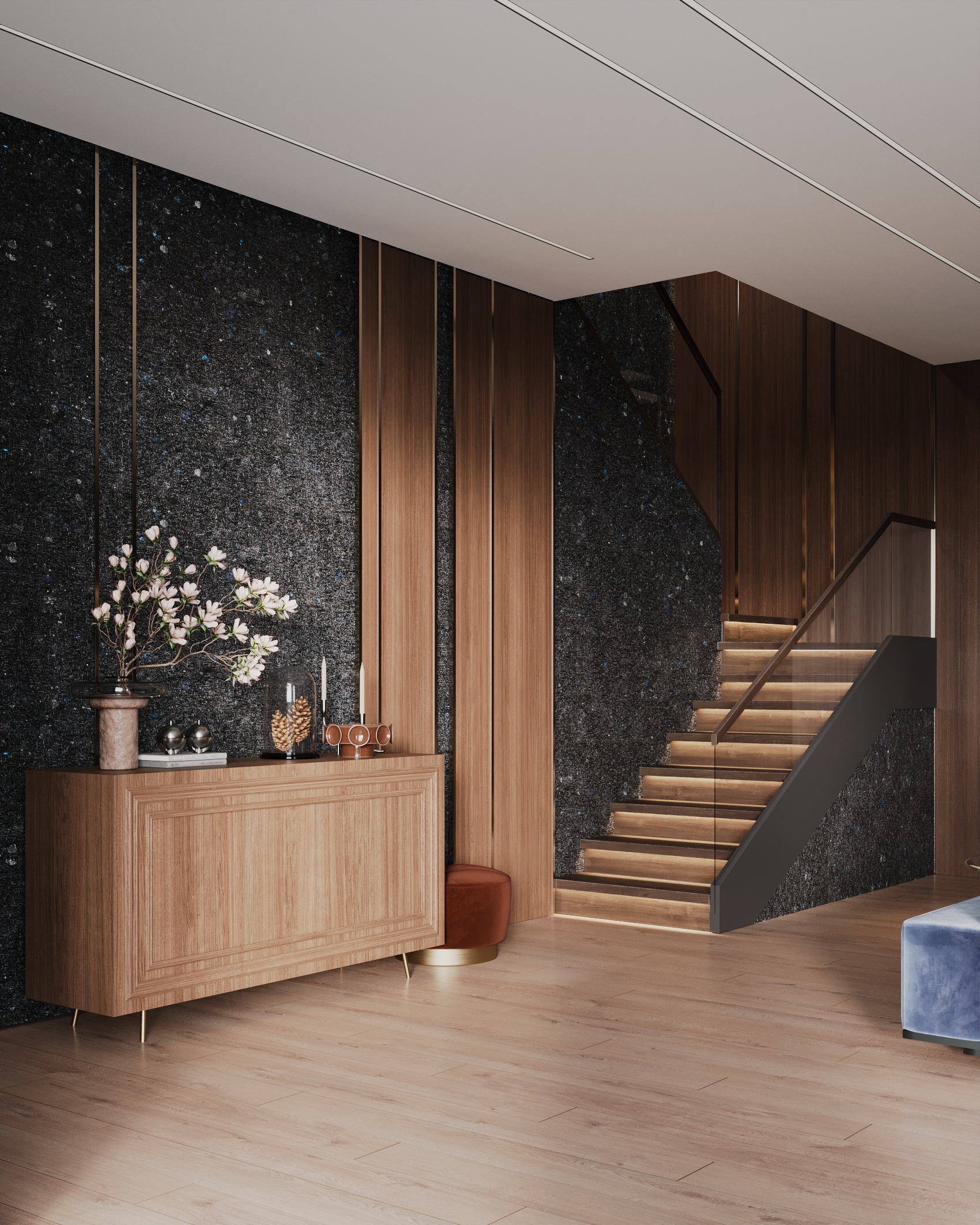
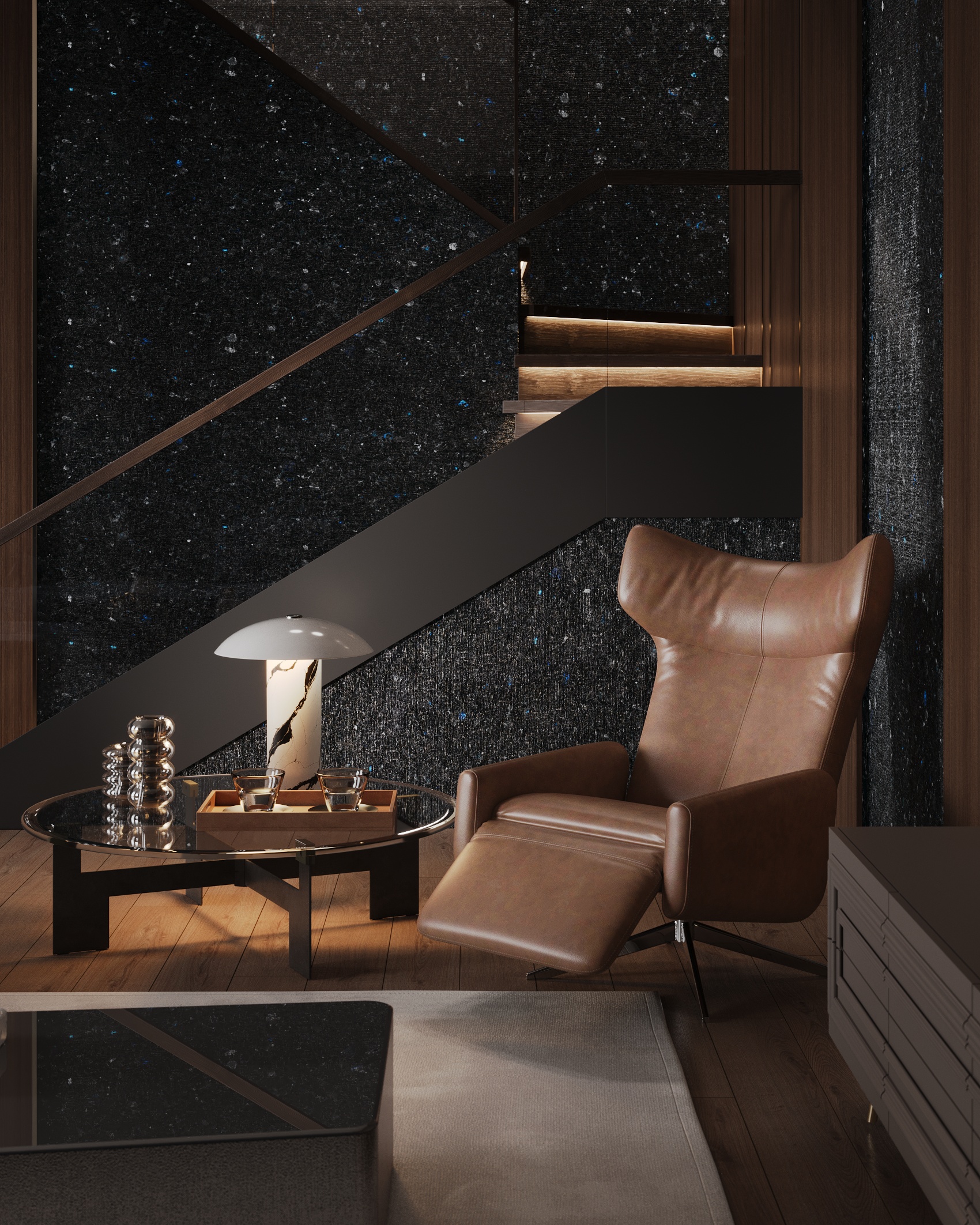
Why Labradorite Works So Well on Stairs
Stairs are among the most demanding stone surfaces in any project. They are exposed every day to dust, footwear, fine abrasives, moisture, temperature changes, and constant movement. That makes material choice especially important.
Labradorite is valued because it holds a strong balance between expression and practicality. It has a dense natural structure, solid hardness, and at the same time preserves the depth of dark tone that clients often search for under terms such as black stone, labradorite, or black marble.
There is nothing overstated about it. Its presence in space feels calm, but strong. That is exactly what makes it convincing in contemporary architecture — from private villas to hospitality and high-end commercial interiors.
Black Stone That Keeps Its Character Over Time
With dark natural stone, it is easy to focus only on the first impression. This is especially true when materials are compared visually and judged mainly by surface effect.
But stairs require a different standard. The question is not only how the stone looks today, but how it will look after years of contact with real life.
In this sense, labradorite feels particularly composed. Its beauty is not built on excess, but on depth, structure, and natural discipline. It does not need visual drama to appear valuable.
That restraint is also what gives it long-term aesthetic strength. It does not become tiring, and it does not feel tied to a passing trend.
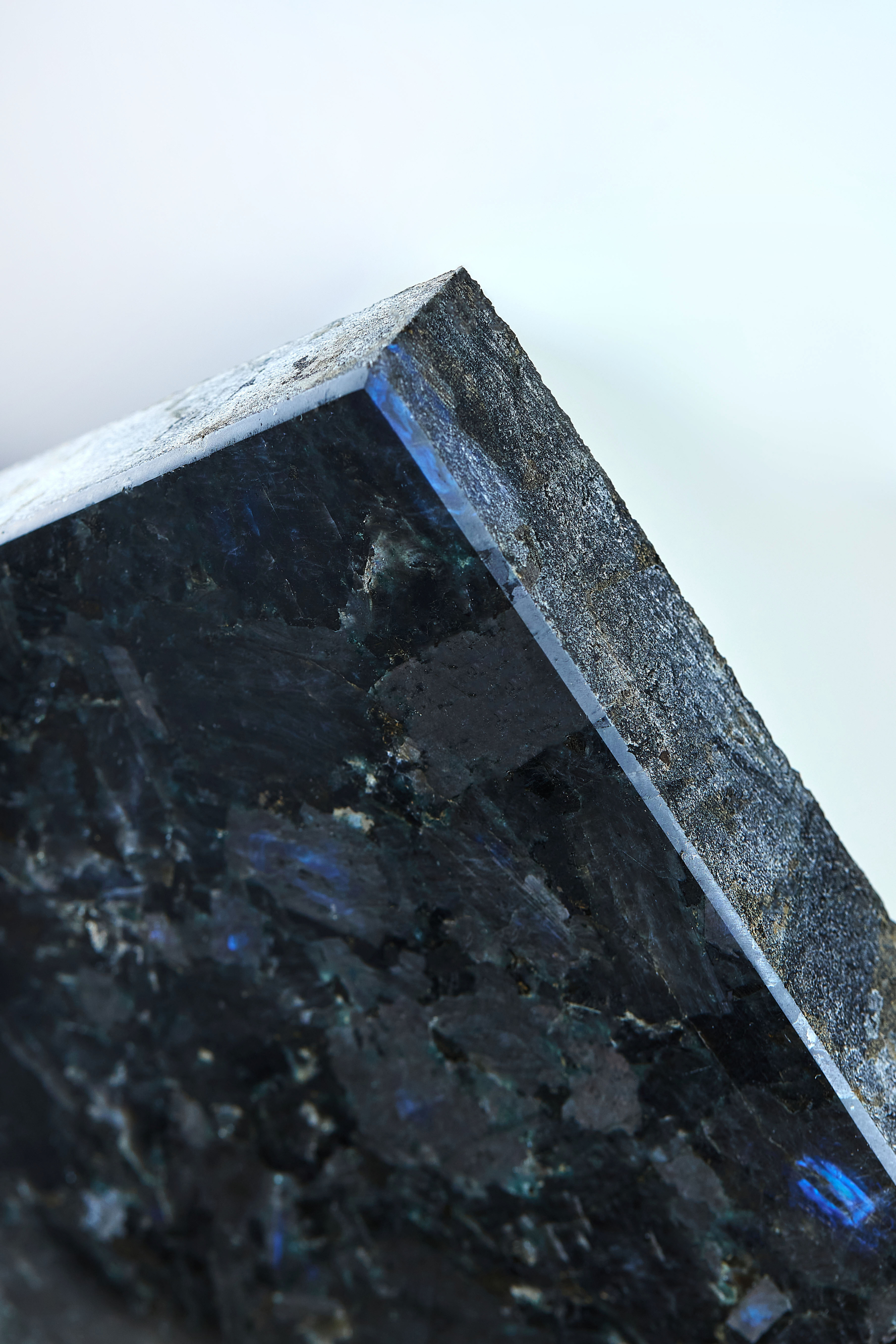
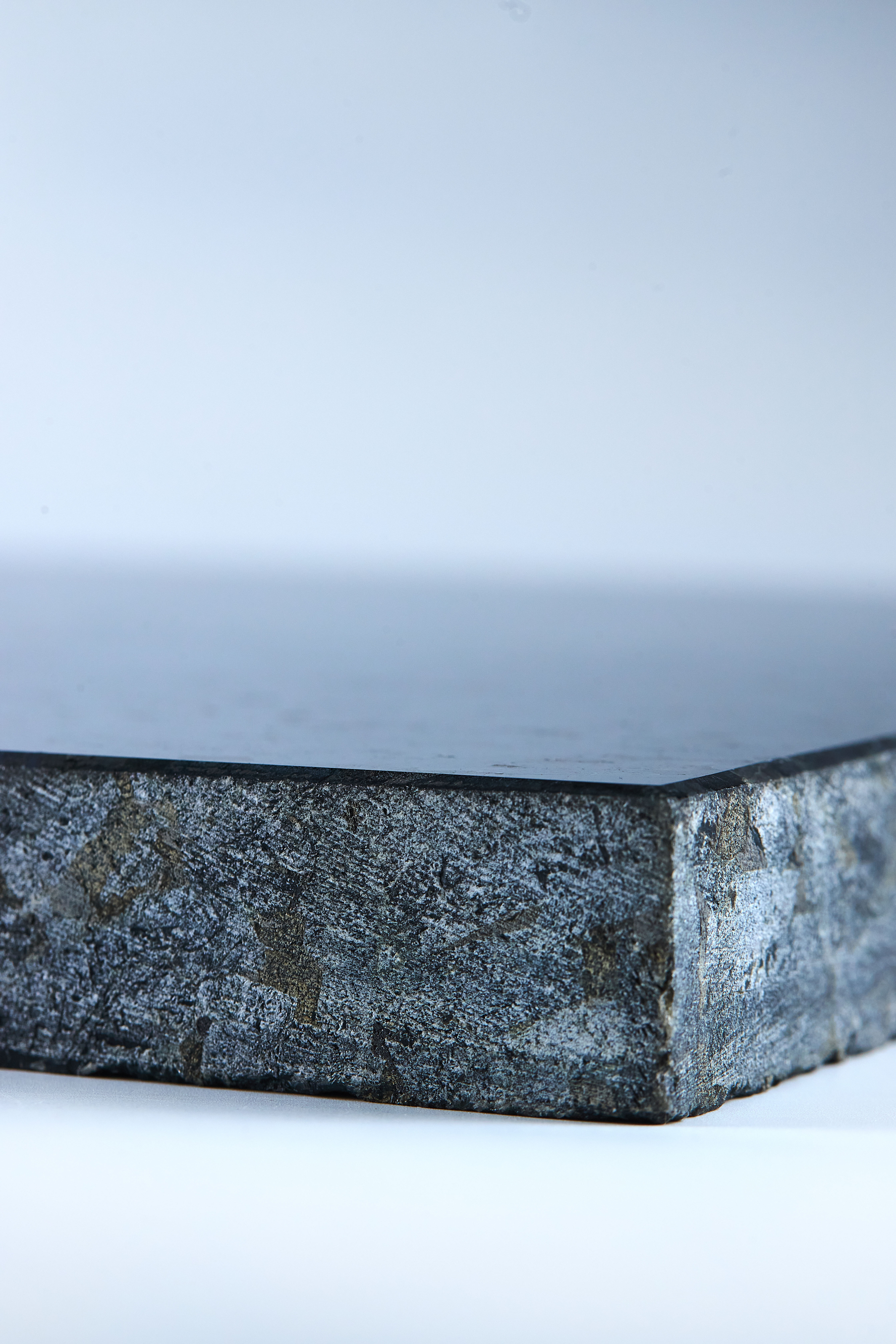
Labradorite or Black Marble for Stairs
Comparison with black marble appears almost every time dark premium stone is discussed. Both materials operate in a similar visual field: dark tone, status, expressive surface, and a refined perception.
But on stairs, an important difference becomes clear. Black marble is often chosen for decorative impact. Labradorite is chosen for its ability to preserve architectural clarity in a more practical context of use.
Its dark tone is no less convincing, yet the material itself feels more architectural in character. There is less theatricality in it and more internal strength.
That is why when a client searches for black stone stairs, labradorite often becomes the most accurate answer. Not because it is louder than other materials, but because it corresponds better to the nature of stairs themselves.
A Natural Pattern That Never Feels Random
One of the defining qualities of labradorite is its uniqueness. Every slab, every stair tread, every cut of stone has its own rhythm and depth.
Yet this expression never feels chaotic. In a strong architectural application, it creates the opposite effect: a sense of order and material cohesion. The stone does not overload the space; it gives it a living, natural presence.
This is one of the reasons labradorite is especially valuable for stairs. It creates a surface that feels unique without being overstated. That quality is difficult to reproduce with artificial materials or overly decorative dark stones.
Labradorite Finishes for Stairs: How the Perception of Stone Changes
Polished — Maximum Depth of Color and Light
A polished finish reveals the depth of labradorite at its fullest. The dark stone becomes more saturated, and the natural pattern becomes more pronounced.
For stairs, this finish works especially well in private interiors where clarity of line, light reflection, and a sense of refinement are important. A polished surface strengthens the monolithic presence of the staircase and can turn it into one of the main compositional elements of the interior.
It feels particularly appropriate where stone is combined with glass, wood, brass, soft lighting, and strong vertical volumes.
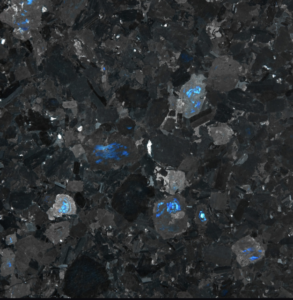
SILK — Restrained Depth Without Excess Gloss
SILK is a finish for projects that need depth without mirror-like reflectivity. It preserves the richness of black stone, but presents it in a softer and more restrained way.
On stairs, SILK feels highly architectural. The surface appears refined, but not demonstrative. It supports contemporary minimalism, soft luxury, and interiors where material calmness is more important than shine.
It is one of the most interesting options for spaces where stone should remain strongly present, but never aggressive.
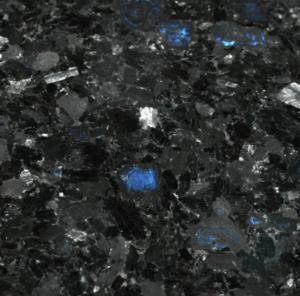
Honed — Calm Matte Expression and Purity of Form
A honed finish gives labradorite a more even, quieter appearance. In this treatment, the stone works more through mass and form than through reflection.
For stairs, it is a strong choice in projects built around large clean planes and balanced geometry. The material feels honest and composed, making it particularly suitable for contemporary spaces that rely on proportion rather than visual effect.
Honed surfaces also work well as a calm background for strong architectural volumes and carefully controlled light.
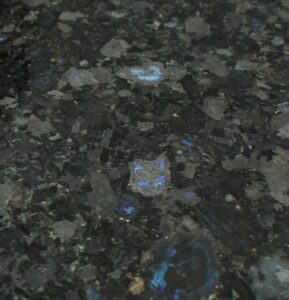
Thermal — Texture, Safety, and the Natural Strength of Stone
Thermal-finished labradorite is especially appropriate for exterior stairs, entrance areas, terraces, and spaces where anti-slip performance is important.
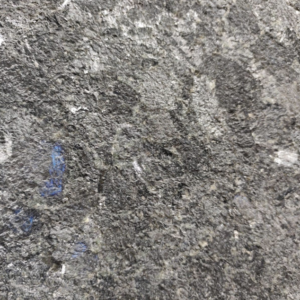
In this finish, the stone looks more textured and more openly natural. It is less about shine and more about material reliability. That makes thermal finish especially relevant in architecture where dark stone must combine a restrained look with practical safety.
For exterior stairs, this is one of the most rational solutions because it brings together visual clarity and functional confidence.
Stairs as Part of a Complete Architectural System
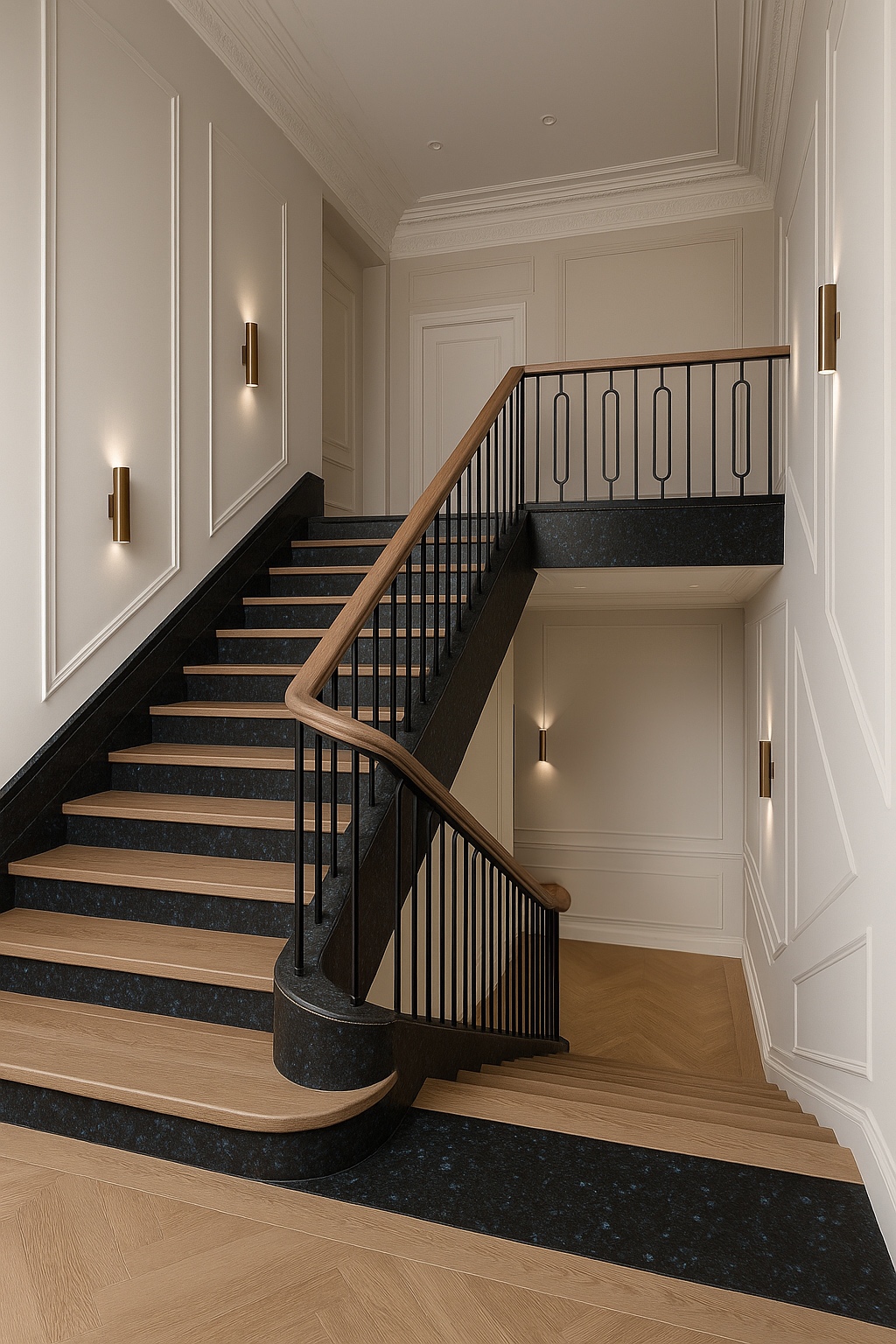
Labradorite performs best on stairs when it is not treated as an isolated element. In a strong project, the staircase can continue the logic of floors, walls, portals, risers, bathrooms, or other stone surfaces.
Then the material begins to act not as decoration, but as part of an architectural structure. That is where true premium quality emerges — not through excess, but through precision.
Labradorite responds very well to that approach. It is expressive enough to hold attention, but restrained enough to preserve spatial balance.
Where Labradorite Stairs Feel Most Appropriate
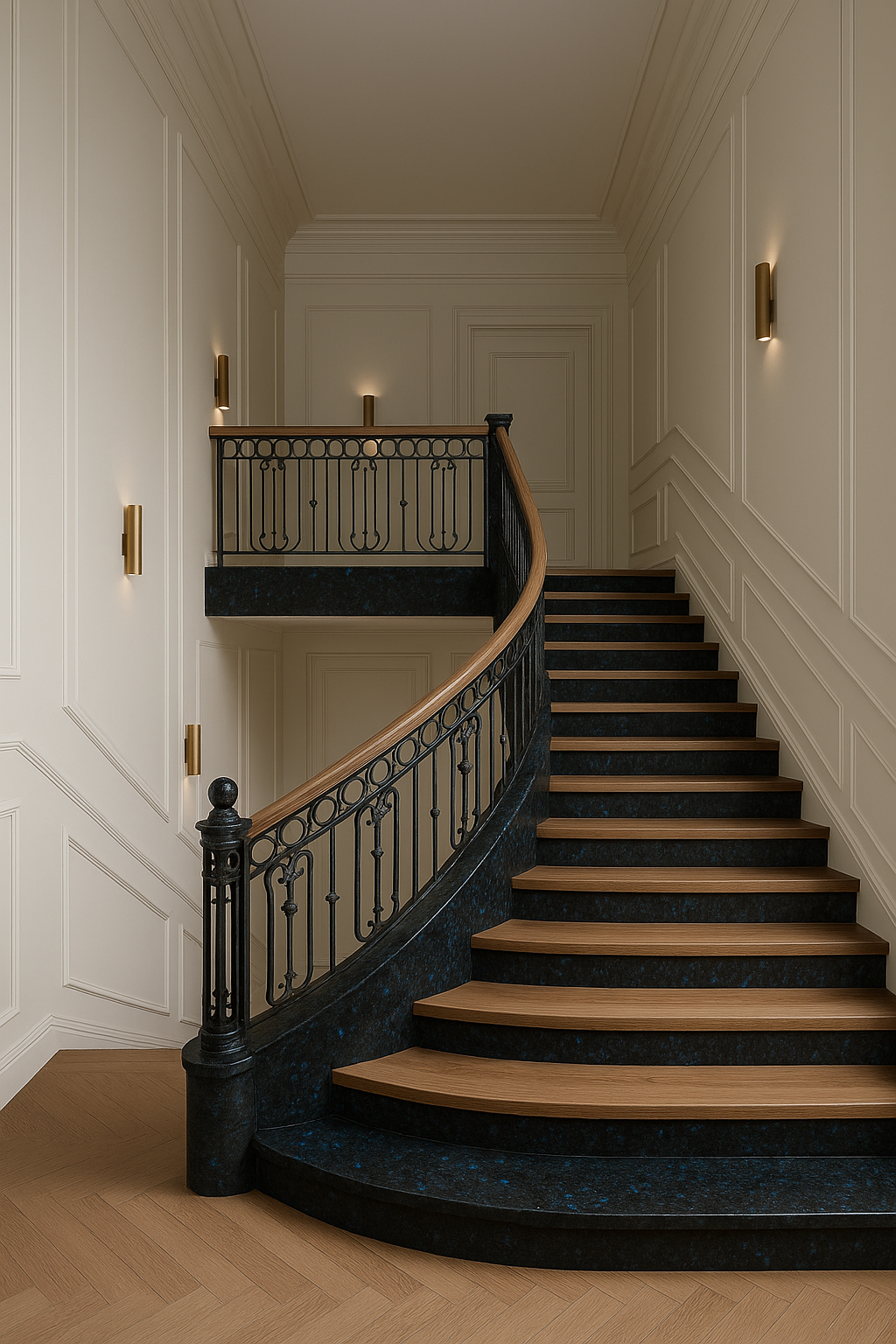
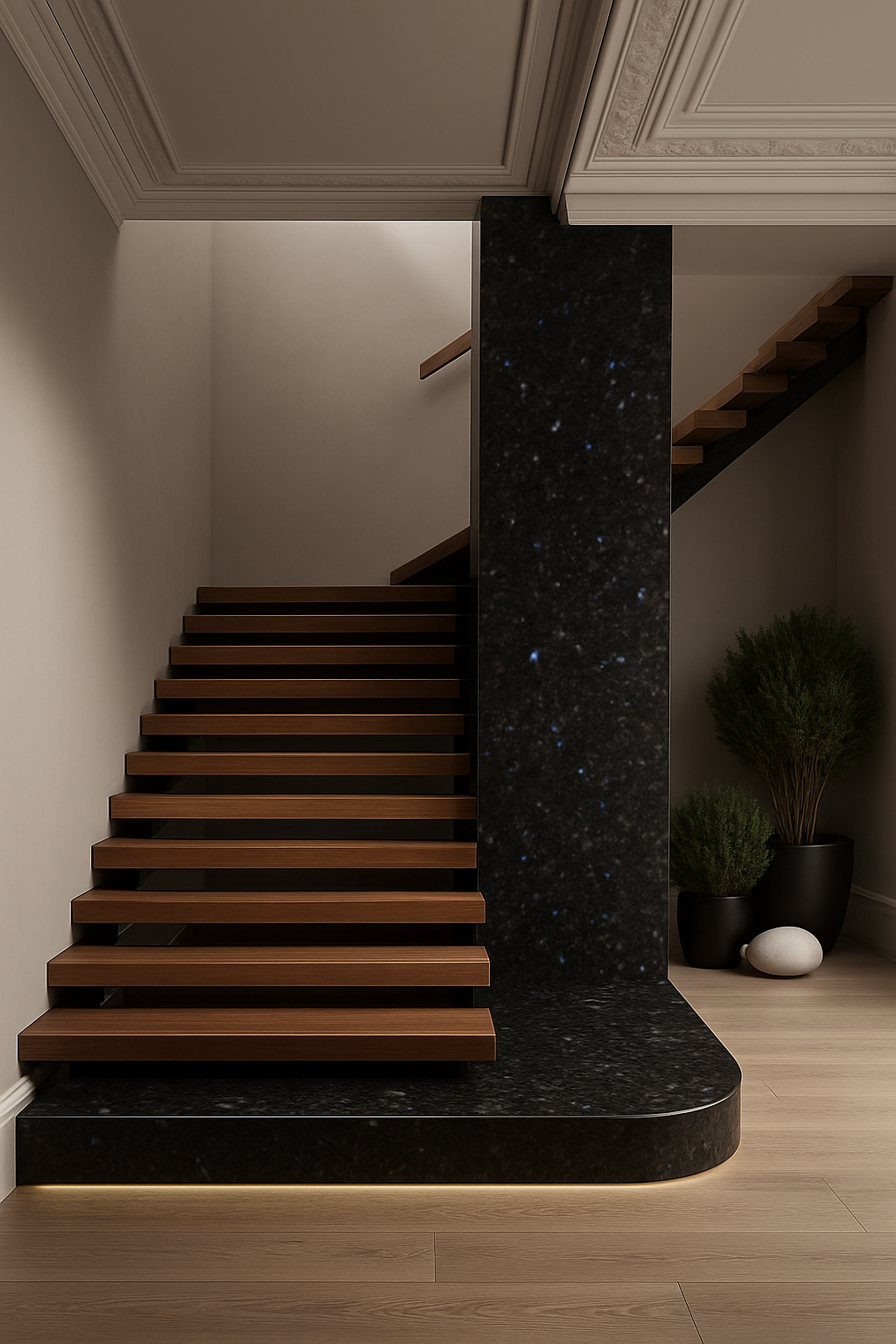
Labradorite stairs feel particularly convincing in contemporary private homes, residences, boutique hotels, showrooms, reception areas, and premium commercial interiors.
In these spaces, black stone does not make the environment feel heavy. On the contrary, it adds depth, stability, and a sense of composed architecture.
This is especially true when the material is chosen not simply as a dark surface, but as stone with its own inner character. That is exactly what distinguishes labradorite — it works not only through color, but through structure.
Why It Is a Long-Term Choice
Stairs are never designed for a short moment. They are expected to remain relevant in the first year and far beyond it. That is why the material used here must have a long architectural life.
Labradorite stairs are the choice for those who want black stone not only with a strong image, but with the ability to hold that image in real use over time.
They combine restrained aesthetics, natural density, noble depth, and a material presence that does not lose relevance. That is why labradorite belongs in architecture designed not for a quick effect, but for lasting presence.